The ecommerce library built by operators who are still running it. Everything. In order. Nothing held back.
Product research, store building, Meta ads, creative testing, scaling, email, offer engineering — in one place, in the right sequence. Written by people running this in 2026. Updated when the landscape shifts.
Real dropshipping pros value this course at $8,000–$15,000. Gurus charge $1,000–$4,000 for less. This is free. Here's everything you get — in order, nothing held back. Read the full library once before spending a dollar, then come back module by module as you implement.
Read end-to-end first — each module builds on the last. Then implement in sequence: no skipping steps, no jumping to ads before the store is ready. Bookmark this page now. Use the nav menu to move between modules. When you hit a term you don't know, open the Glossary. When you have a question, check the FAQs first. Stuck on a creative or store? Drop it in the Discord for real operator feedback.
You already know something is off.
Maybe you've spent hours on YouTube and every video ends with a link to a $997 course. Maybe you tried it, lost money, and can't figure out what specifically went wrong. Maybe you're already running ads but the results are inconsistent and you don't know whether to keep going or cut.
This library was built for that gap — from "I want to do this" to "I actually know what I'm doing." The complete system, one place, correct sequence, nothing held back.
The single reason most people fail at dropshipping has nothing to do with finding the right product. It has nothing to do with their store design, their niche, their budget, or their timing. They fail because they think this is a product discovery game. It is not. It is a creative testing operation.
The operators consistently making money in 2026 aren't sitting on some secret product catalog. They test more creatives, read data without emotion, kill faster, and iterate with discipline. A product that looks completely ordinary will destroy a "perfect" product if the ad selling it is better. That shift — from looking for the right product to building the right testing system — is the foundation everything else in this library builds on. If you take nothing else from this page, take that.
What You're Actually Getting Into — The Real Numbers
Most ecommerce resources will tell you about the upside and let you discover the math yourself. This one won't. Here's what this actually costs and how long it actually takes, so you can make an honest decision before you start.
The range here is wide — and that's intentional. Many operators make money from their very first product launch when they follow the framework correctly. Others need 10–15 tests. Both outcomes are real. The framework exists precisely to compress your path toward the left side of this table.
| Starting Capital | Stores You Can Launch | Cost Per Test | Realistic Timeline |
|---|---|---|---|
| $100–$300 | 1 store launch | $100–300 | Days to weeks for first signal |
| $500–$1,000 | 2–4 store launches | $100–300 | 1–2 months to meaningful data |
| $1,000–$3,000 | 4–10 store launches | $100–300 | 2–4 months to first winner likely |
| $3,000–$5,000 | 10–15+ store launches | $100–300 | Full run to find a winner at any base rate |
1–2 tests per week at $100–300 each. Some tests show clear signal in 3–4 days. Some need 7 days for enough data. The operators who hit the low end of this table are the ones who follow the module sequence without skipping steps, read data honestly, and don't second-guess the framework mid-test. That's the entire point of this course — getting you to the left side of that table.
The money has to be genuinely available — not "I could move it around," not borrowed, not your emergency fund. Available and deployable. If $300 is a stretch right now, read the full library first, build your capital, then start when you can run 2–3 tests without financial pressure affecting your decisions.
Is Dropshipping Still Actually Worth Doing?
This is the question almost everyone has when they start researching — and the honest answer is: it depends entirely on which version of dropshipping you're talking about.
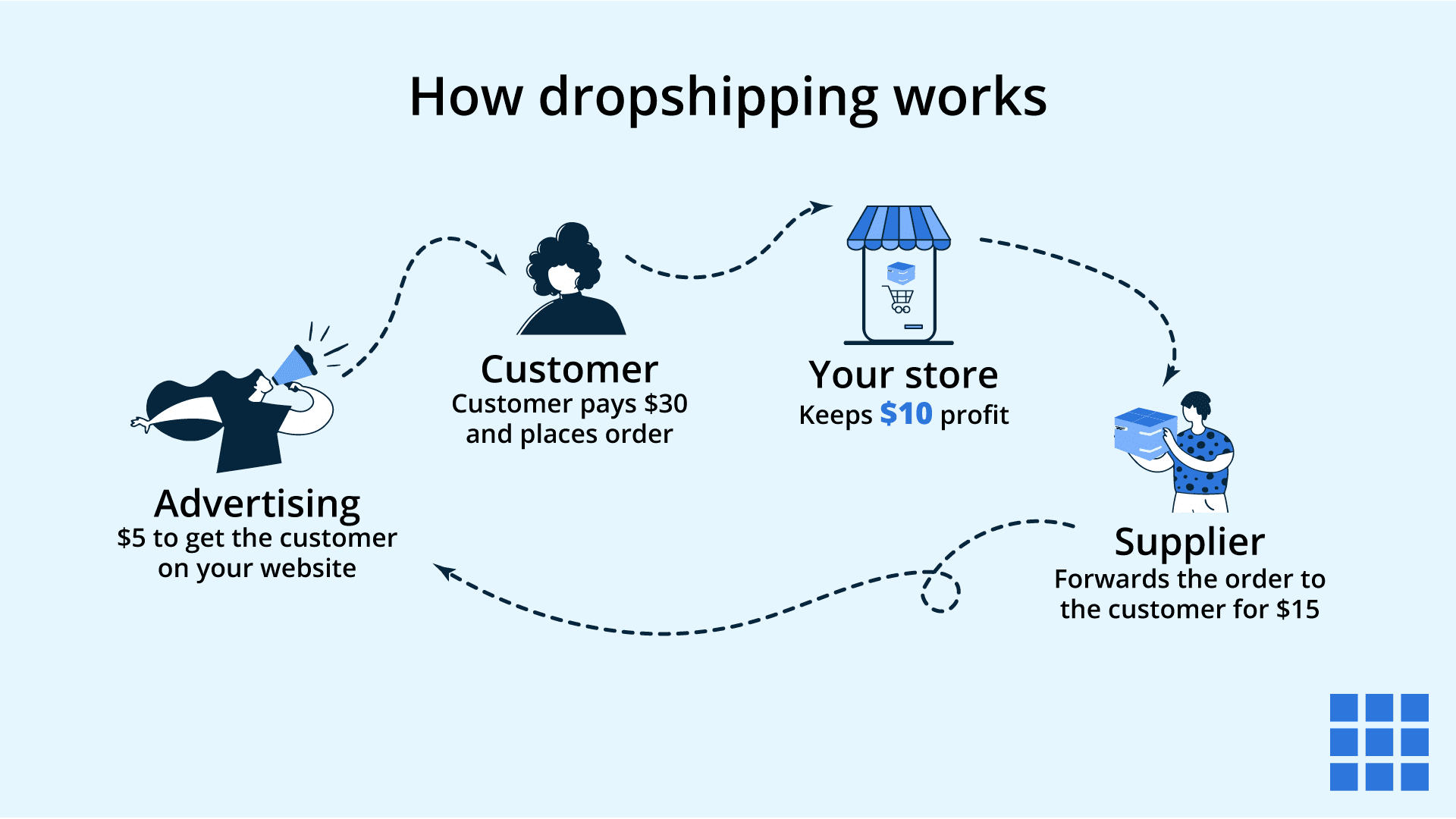
The version that's dead: find a cheap product on AliExpress, mark it up 5x, build a generic store, run one Facebook ad, and watch the orders come in. That stopped working years ago. Temu and Shein now have US and EU warehouses. They ship faster than most dropshippers. They're selling the same generic products for less. Anyone still teaching the 2018 model is selling you something that will lose you money in 2026.
The version that works: find a product that solves a real problem in a real niche, build a store that positions it correctly, create 30–50 ad variations across multiple emotional angles, launch to a broad audience, read the data honestly, and double down on what converts. This requires more work than the old model. It also works. The operators doing this consistently are building real cash flow — not YouTube thumbnails.
The difference isn't the niche. It isn't the product. It isn't even the budget. It's the system. And the system is what this library teaches.
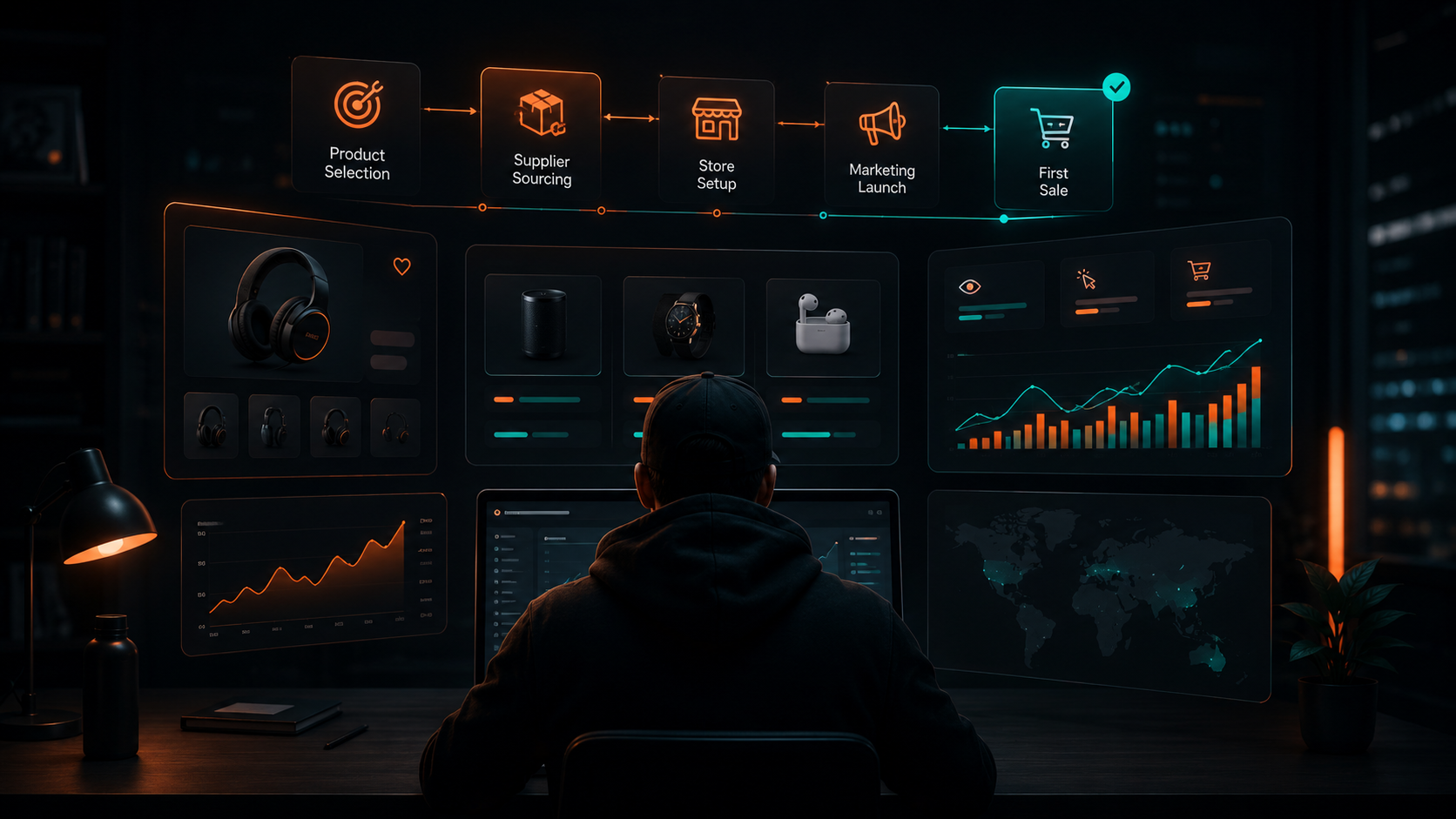
The Exact Order That Works — Don't Skip Steps
This sequence isn't a recommendation. It's the result of watching what happens when you do things out of order — and it's almost always expensive. Follow it exactly.
- Find a product with proven market demand — Not a product you find exciting. A product you can verify is already selling for other people. Spy tools, Meta Ad Library, TikTok organic. Competition means the market exists. Ignore it and you're guessing.
- Confirm your supplier and margin before touching Shopify — Pricing, shipping time, minimum order, and real cost of goods locked in first. CJDropshipping to start. Private agent after you're at 5–10 orders per day consistently. Never build a store around a product you haven't sourced yet.
- Build a fast, functional store — not a perfect one — Clean, trustworthy, loads quickly, easy to buy from. That's the brief. If you've spent three weeks designing your store before a single real customer has seen it, you've optimized the wrong thing. A store that goes live in 3 days gets data. A perfect store that never launches gets nothing.
- Create 30–50 ad variations across 4–6 emotional angles — Not one ad. Not "a few." Thirty to fifty. Static and video, different hooks, different pain points, different visual formats. Volume isn't laziness — it's the only way to give the algorithm enough to find who buys. The creative is the targeting.
- Launch one CBO campaign, broad audience, let it run — No stacked interests. No complicated ad set structure. One campaign, broad targeting, $50–100/day. Let Meta's algorithm find your buyers. Your creatives do the targeting. Trust the process for at least 4 days.
- Read data on day 4 and day 5 — then make decisions — Not day 1. Not after $30 in spend. You need enough data for the algorithm to learn and enough spend to see a real signal. Kill clearly dead creatives. Double down on winners. Iterate angles that show partial promise.
- Build the backend only after the front-end is working — Email flows, CRO improvements, offer engineering, upsells. These compound results. They cannot manufacture results from nothing. Do this after your first profitable week, not as a pre-launch ritual that delays you indefinitely.
Bookmark this page
- Press Ctrl+D (Windows) or Cmd+D (Mac)
- On mobile: tap the share icon → Add to Home Screen
- You'll come back to specific modules when campaigns start moving. One click beats hunting for it.
What This Actually Costs and How Long It Actually Takes
Most courses skip this. The honest math matters more than any other single thing in this library, so here it is upfront.
| Reality Check | The Numbers | Why |
|---|---|---|
| Products to first profitable one | 1–15 products | Many operators following this framework make money from their first launch. Others need more tests. The range is real — following the course properly pushes you toward product 1. |
| Cost per product test | $100–$300 | $50–100/day × 3–5 days to get a clear signal. Some tests resolve faster. This is the real cost of a properly run test. |
| Total investment to first winner | $100–$4,500 | Best case: 1 product × $100 = $100. Realistic outer bound: 15 products × $300 = $4,500. Follow the framework and you’re more likely near the left than the right. |
| Time to first sale | Days to weeks | Operators who follow the course sequence — correct validation, 30–50 creatives, proper launch setup — can see first sales within days. Skipping steps extends this significantly. |
| Time to consistent profit | Weeks to months | First sale is not consistent profit. Data reading, angle iteration, and cash flow management compound over time. Most operators get there — timeline depends on execution speed. |
These ranges are intentionally wide. Many operators who follow this course properly make money from product 1. Others need more tests. The difference is almost always process — correct product validation, proper creative volume, honest data reading, and following the module sequence without skipping steps. The framework is designed to get you to the left side of this table. Whether you land there depends on how closely you follow it.
You can run a proper first test for $100–300. What you can’t do is spend $20, see no sales, and conclude “this doesn’t work.” Starting undercapitalized — spending too little to get a real data signal — is the most common reason people fail early and blame the model. Have $300–500 ready before your first launch so you can run the test properly and have budget to iterate if needed. Many people who follow this course make money from their very first product. Give yourself the runway to be one of them.
If You've Already Tried and Lost Money — Read This Section
Most people who tried dropshipping and failed didn't fail because ecommerce doesn't work. They hit one or more of the patterns below and didn't have a way to recognize it. Go through the list and find the exact thing that went wrong.
- You tested with too little budget. $50 in ad spend is not a test — it's a coin flip. The Meta algorithm needs time and spend to find patterns. A real product test requires $100–$300 minimum. Under that threshold, you are not generating data. You are generating anxiety.
- You launched with 2 or 3 ads. The algorithm has nothing to work with. Three ads is three hypotheses. You need 30–50 variations across multiple angles before you can honestly say whether a product has potential. One winning creative can come from angle #31. You'll never know if you stop at three.
- You built the perfect store before testing anything. Two weeks of Shopify design before a single real visitor has seen your page is two weeks of wasted capital. Speed to data is the only real advantage a new operator has over an established one. Ship a clean, functional store in 3 days and get real feedback.
- You killed the campaign after one bad day. Day 2 is not a verdict. "15 orders yesterday. 1 today. Same spend. Nothing changed." This happens constantly and it's completely normal — Meta's delivery fluctuates. One bad day is noise. Four consecutive bad days with no signal anywhere is a reason to evaluate. Learn the difference.
- You kept running a dead product for weeks. The opposite mistake. Sunk cost psychology keeps campaigns alive long after the data says they're finished. Know your exit criteria before you spend your first dollar. Write it down. Hold yourself to it.
- You stacked interests in your targeting. Adding 6 audience interests in 2026 doesn't help Meta — it restricts it from finding buyers it would have discovered organically. Broad targeting with strong creatives outperforms interest stacking in almost every test that's been run in this community. Stop fighting the algorithm.
- You ran one ad and waited. One ad is one hypothesis. You have no idea which element of that ad is causing it to perform or fail. Operators who scale consistently don't have better creative instincts — they run more tests and let real data decide.
- Your product page was killing the ads. A genuinely strong ad sending traffic to a slow, cluttered, or unconvincing product page is like a powerful engine in a car with flat tyres. The store is part of the funnel. A bad page destroys good ad spend.
- You scaled budget on a broken creative. More budget behind a losing ad just burns money faster. Budget amplifies whatever is already happening — positive or negative. If results plateau, the instinct to "scale into it" is almost always wrong. Fix the first 3 seconds of the creative first.
- You expected consistent results from the start. New operators expect a straight upward line. Real operators expect a messy, inconsistent signal that gradually becomes readable as they accumulate more data. That early phase ends when you stop trying to shortcut it.
If three or more of those hit close to home — that's not a sign ecommerce doesn't work. It's a sign you were playing a game you didn't yet have the full rules for. You have them now. The next test is different.
What If You Don't Have the Budget Yet?
This is the most common honest concern — and it deserves a direct answer.
The minimum realistic budget to run a proper first test is $300–$500. That covers ad spend for a meaningful test period, basic Shopify subscription, and a small buffer. You could get lucky with less. You could also lose $150 on a test that didn't have enough data to tell you anything useful — and that's worse than not starting.
If you genuinely don't have that yet, the right move is not to find a way to start anyway with half the capital. The right move is to build the budget first. For some people that means picking up freelance income using the same skills this ecosystem teaches — ad creative production, AI content, ecommerce support work. You build capital and skills at the same time.
Have at least $300 you can genuinely afford to lose before you run your first ad. Not money you borrowed. Not money earmarked for rent. Not money you'll panic about at $150 spent. Keep 30% of your total available capital in reserve at all times — never all-in on one test. Underfunded tests produce bad data, bad decisions, and real losses. Start from a position of stability, not desperation. The people who succeed in this space aren't the ones who bet everything — they're the ones who manage their testing capital like a professional, not a gambler.
If you genuinely don't have that yet, the right move is not to find a way to start anyway with half the capital. Build the budget first — and while you're doing that, read this whole library so that when you are ready, you're not starting from zero knowledge.
How to Know If This Is Worth Your Time
The ecommerce information space is full of people whose actual business is selling the idea of ecommerce — courses filmed in 2021 still being sold in 2026, content designed to hit a paywall on page 3. Here's how to verify this one.
The advice here contradicts what most paid courses teach. Broad targeting when gurus still teach interest stacking. 30–50 creatives when popular advice says test 5–10. Don't scale budget until the creative is proven, when most content says scale early. Read it — if it holds up under scrutiny and matches what you see in real ad accounts, use it. If not, you've lost a few hours — but you didn't pay $5,000 to a guru like most people do and lose money.
There's a live community of operators running this system. The Discord is free. You can read the thread history — the actual questions, the actual answers, what breaks, what works. That's verifiable in a way a screenshot testimonial isn't.
What This Library Covers — The Complete Map
Product research on real data. Supplier sourcing without inventory. Store that converts without weeks of design. 30–50 ad creatives using AI tools, footage from social media platforms, and supplier footage. Meta campaign structure for 2026. Reading data day-by-day. Kill/scale logic. Email flows for abandoned checkouts. Offer engineering for higher AOV. Ad account protection. Budget scaling. Brand transition. Supply chain upgrades. Customer retention.
Every module is sequenced. Every concept is immediately actionable.
This is not a TikTok Shop or organic content playbook. It doesn't cover Amazon FBA, print-on-demand, or wholesale. It doesn't cover Google, YouTube, or Pinterest ads. The acquisition model here is built entirely around Meta paid advertising — Facebook and Instagram — because that's where the systematic testing approach covered in this library works best and where most operators in this community are operating. Different channel, different library.
Who Gets the Most Out of This
- Complete beginners who are tired of 200 scattered YouTube videos and want one ordered system they can follow start to finish without guessing what comes next.
- People who tried and lost money and want to understand — specifically, diagnostically — what went wrong and what to do differently the next time.
- Operators already running ads who feel like something is slightly off — inconsistent results, unclear kill/scale logic, not enough creative volume — and want to sharpen a specific part of the system.
- People who paid for a course and found it was 2021 knowledge dressed up in new packaging, or designed to move you into a higher-priced offer that also wasn't worth it.
- Anyone who needs to build capital first and wants to understand the full system before they have skin in the game — so when they do have the budget, they're not starting from zero knowledge.
Read in order. Implement as you go. Come back when you need it.
- 1Read the whole thing end-to-end before you spend a dollar. It takes a few hours. The reason: each module is designed knowing what comes before and after it. Understanding the full system first makes every individual module more useful when you're in the middle of actually running it.
- 2Follow the sequence when you implement. The order isn't a suggestion. Operators who skip to ads before validating a product, or build a store before confirming supplier margins, consistently hit expensive, avoidable problems. The sequence is there because it works.
- 3Bookmark this page now. You'll come back to specific modules mid-campaign — when results are inconsistent, when you're deciding whether to scale, when something breaks. Ctrl+D / Cmd+D.
- 4Implement, then continue. Reading 20 modules in one afternoon without doing anything produces zero results. Finish a module. Do the thing it describes. Then move to the next one.
- 5Come back as your stage changes. The Kill/Scale module reads completely differently after you've spent $300 on a real test than it does right now. The Scaling module becomes critical the first time you have a winning creative. This library compounds with experience — revisit it regularly.
- 6Bring your questions to the community. The Discord is free and active. Operators at every stage — first product test to multi-product scaling — are working through the same system in real time. Real questions get real answers. Join before you need it, not after.
It isn't budget, niche, or talent. It's executing the system as written, without skipping steps, and running another test when the first one doesn't work. Every operator making consistent money in this community went through a stretch where nothing was working and ran the next test anyway — because they were buying data, not results. That reframe makes every failed test worth the cost.
Before you move to Module 02, you should be clear on:
- This is a creative testing operation — not a product discovery lottery
- You need $300–$500 genuinely available before your first test — not borrowed, not earmarked
- Follow the execution sequence in order — skipping steps is expensive
- Read the full library once before spending anything — then come back module by module
- Bookmark this page. Join the Discord. Return here often.

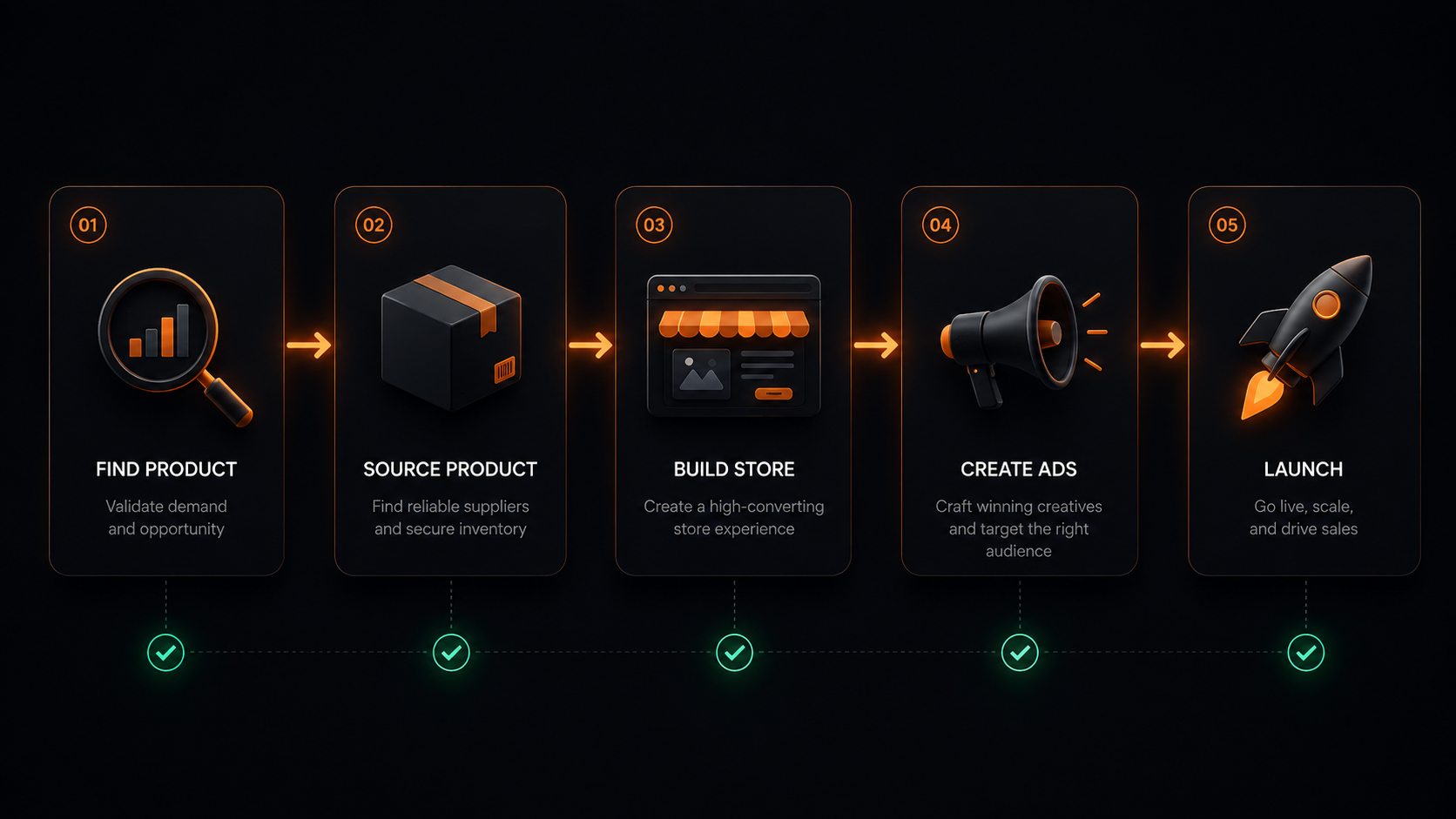
Quick reference — the 7-phase roadmap
The whole journey from first product to scaled brand, at a glance.

Not sure if you're actually ready for this stage?
Get your free Readiness Score — 10 questions, 90 seconds, tells you exactly which gaps to close first.
