Audience Research — Your Customer Has Already Written Your Ads
Every hook, every headline, every objection handler you need already exists. It's sitting in Amazon reviews, Reddit threads, and TikTok comments — written by your exact customer, in their exact words, describing their exact pain. Your job isn't to write copy. It's to find it, organize it, and reflect it back at them so precisely they think you read their mind.
Most operators pick a product, then try to figure out what to say about it. This is backwards — and it's why so many first ads feel generic and convert poorly. When you understand your buyer's exact language and specific fears before you choose the product, you enter the product selection process already knowing which angles will land, which hooks will stop the scroll, and which offer structures will overcome the objections your customer has before they've even seen your store.
This research takes 2–3 hours the first time. It is the highest-leverage 2–3 hours you will spend in this entire process. Operators who skip it write copy that sounds like them. Operators who do it write copy that sounds like their customer. One of those converts.
The Voice-of-Customer Mining Method
This single technique is responsible for more profitable ad campaigns than any other skill in this entire library. Real customers, writing in their own words about their real problems, in publicly accessible places you can read right now — that is your ad copy. All of it. The best hook you'll ever write is already sitting in a 3-star Amazon review. Your job is curation, not invention. Find the language. Use it verbatim.
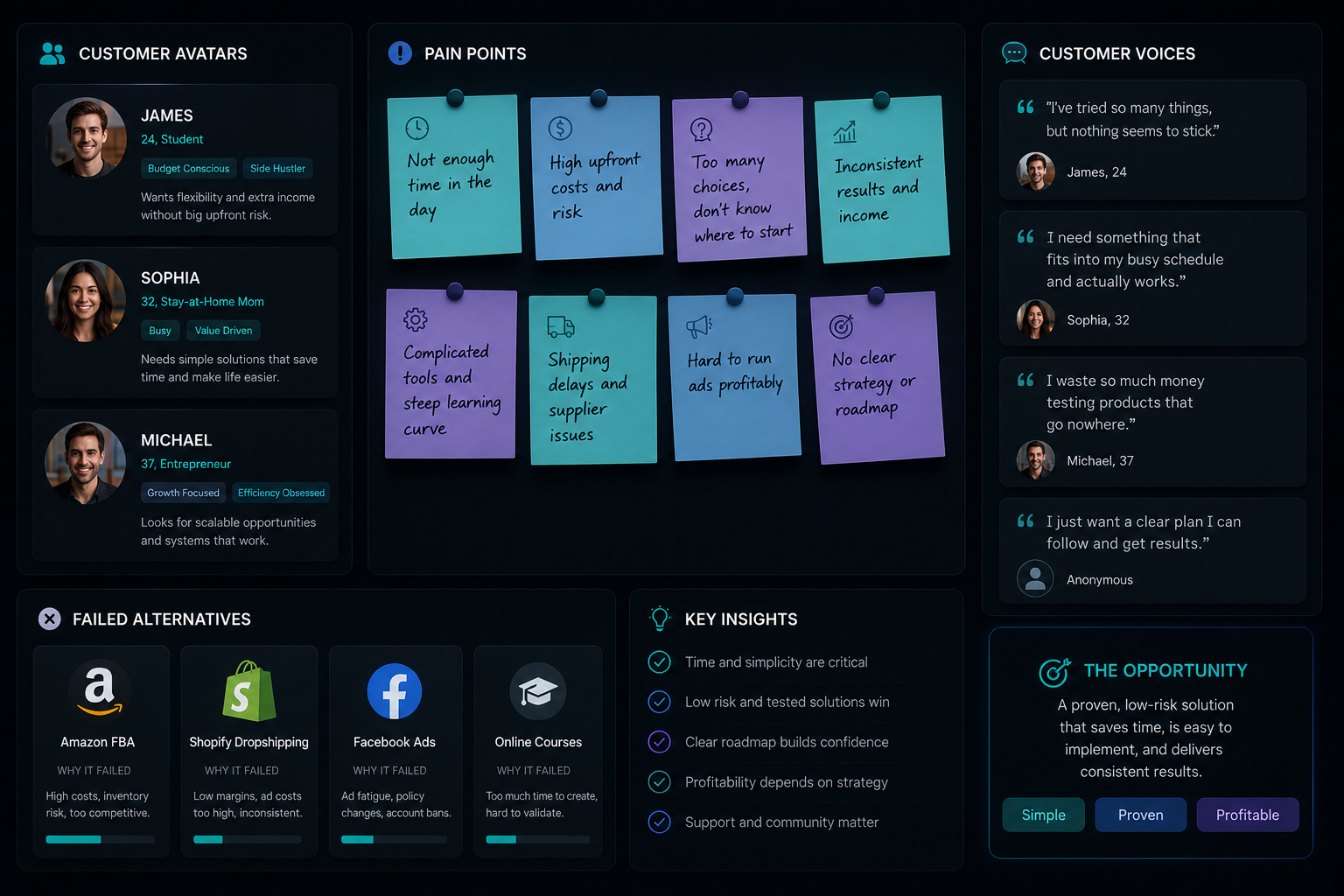
Go to Amazon. Find 3–5 top-selling products in your niche with 500+ reviews. Read the 4-star and 5-star reviews (what people love), but focus especially on the 2-star and 3-star reviews (what they wish the product did differently). The language in bad reviews is your hook material: "I tried everything for my knee pain until I found..." These are stories your customers are already telling themselves.
Open Amazon for your niche and copy 5 real customer quotes
- Search your niche product on Amazon. Sort by top-rated reviews.
- Read 3-star and 2-star reviews. These have the rawest pain language.
- Copy 5 phrases into a notes doc. Word for word. These are future ad hooks.
Open your product's Amazon listing and mine 3 hooks
Read the 2–3 star reviews. Copy any sentence that describes pain in specific, emotional language. "My knees sound like gravel" — that's a hook. "I can't sleep on my back anymore" — that's a hook. Find 3. Write them down. These are your first ad hooks.
Search Reddit for your niche: r/kneerehab, r/skincare, r/dogadvice. Sort by "Top" and "All Time." Read the most upvoted posts about problems your product solves. These are your authentic testimonials. Copy the exact phrases people use when describing their pain. "My knees sound like gravel when I walk" is an ad hook. "I've been embarrassed to wear sleeveless tops for 5 years" is an ad hook. None of that was invented.
Find TikTok videos about your niche with 100K+ views. Read the comments. People leave the most emotionally raw responses to video content — especially pain-related content. "This is literally me omg," "I've tried everything," "Where can I buy this???" are signals. The questions ("does this actually work for X?") are your FAQ content and objection handlers.
Join 2–3 Facebook groups in your niche. Don't post — just observe for a week. The recurring questions, the complaints about existing solutions, the "has anyone tried X?" posts — these tell you exactly what your audience wants that the market isn't currently delivering well. Those gaps are your product angles.
Building Your Persona — The Targeting Foundation
Before spending a dollar on ads, define exactly who you're talking to. Not a demographic — a person. A specific person with a specific problem and specific language patterns.
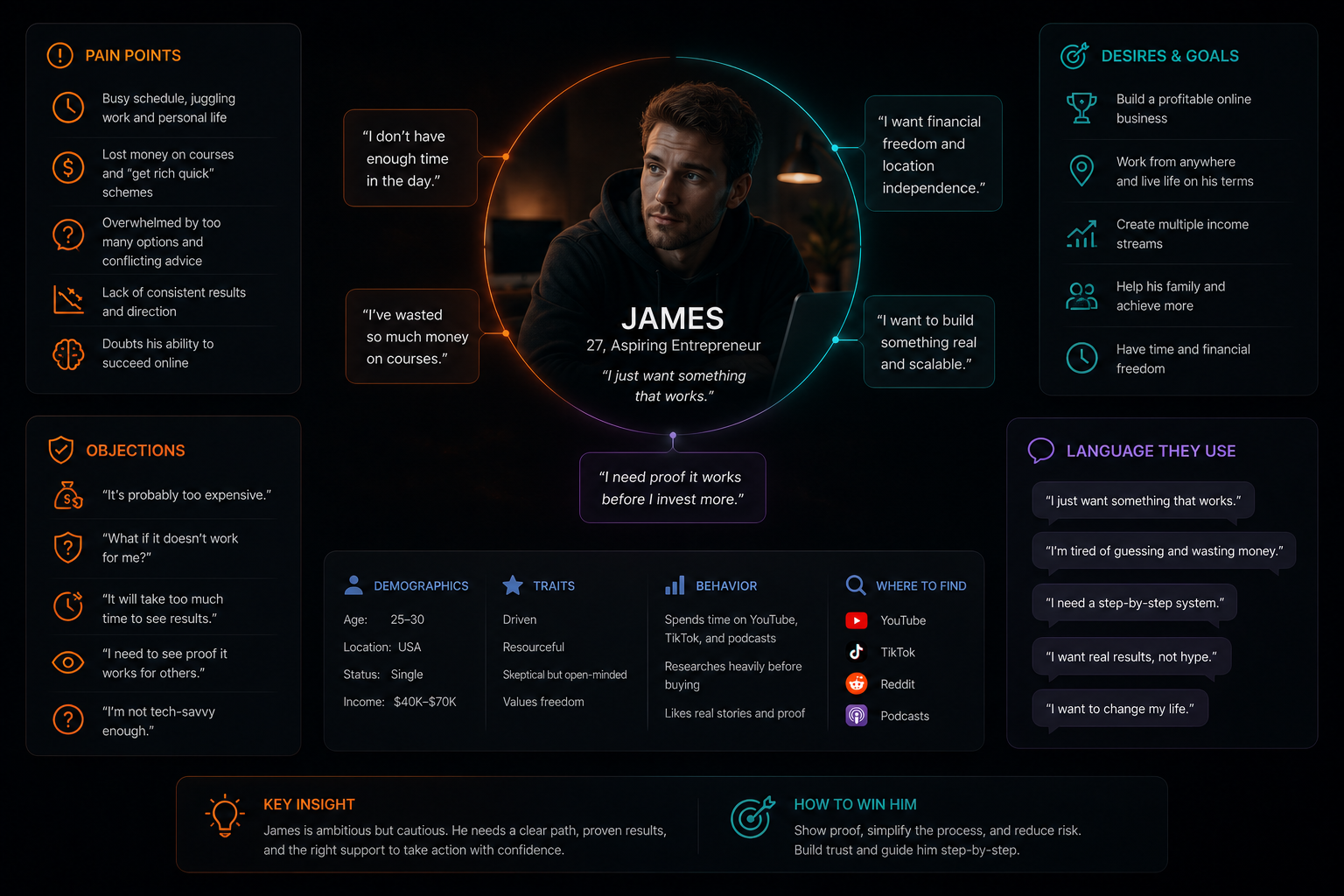
- Name and age: Give them a name. "Sarah, 52" makes copy decisions faster and more specific than "women 35–65."
- The pain in their exact words: Copy 5–10 direct quotes from your research. Not paraphrased — verbatim.
- What they've already tried: Other products, doctors, exercises. This is your "failed alternatives" angle.
- What they're afraid of: That it won't work. That they'll spend money and be disappointed. That it's too good to be true. Address this in your copy.
- What success looks like to them: Not "less pain" — specific: "being able to play with my grandchildren without wincing." This is your desired outcome and your ad's payoff.
- Where they spend time online: Which Facebook groups, which TikTok accounts, which media they trust. This informs your creative style and tone.
Create a folder (Notion, Google Docs, or even a text file) for your niche research. Paste in every great quote you find, organized by category: pain descriptions, desired outcomes, failed alternatives, objections, trust signals they respond to. This folder becomes the raw material for every ad you write. Operators who skip this step write generic copy. Operators who do this write copy that sounds like their customer wrote it themselves.
Additional Research Sources — Go Deeper
The four steps above give you the core voice-of-customer data. The sources below add competitive intelligence and post-sale insight that most operators never use — which means using them gives you an unfair advantage.
Watch competitor ads closely — not just the creative, but the comments. The comment section of a high-volume competitor ad is one of the richest research sources you have access to. What do people love? What do they question? What objections appear repeatedly? Comments asking "does this work for X?" are telling you exactly what pain points resonate with the audience. Comments saying "I've tried everything" confirm the Failed Alternatives angle. Mine these systematically before writing a single word of your own copy.
Spy tools let you analyze successful competitor ads at scale — seeing what's trending, which ads are running longest (a proxy for profitability), and which audiences are being targeted. Pipiads is strong for TikTok ads specifically. Kalodata provides TikTok Shop revenue data. Minea covers Meta, TikTok, and Pinterest. Use these to research angles, not to copy creatives. The goal is understanding what messaging the market responds to, then expressing it in your own voice with your own product. Note: spy tools are useful early-stage training wheels — experienced operators rely less on them as their own creative testing builds intuition.

Once you have customers, the most direct research source is asking them why they bought. Build a simple 3-question survey in Klaviyo or Google Forms and send it 7 days post-purchase: (1) What made you decide to buy? (2) What problem were you trying to solve? (3) Where did you first hear about us? Their answers tell you exactly what parts of your ads and offer worked — and what to emphasize in your next round of creatives. The language customers use to describe why they bought is often the exact headline for your best-performing ad.
Start with free sources (Amazon reviews, Reddit, TikTok comments, Facebook Ad Library). Use paid spy tools to confirm and expand what you found — not to replace the manual research. Free sources give you raw customer language. Paid tools give you scale and competitive context. Both are necessary. Neither alone is sufficient.
You should now have:
- A research folder with 20+ real customer quotes from Amazon/Reddit/TikTok
- A completed persona template (name, pain, failed alternatives, desired outcome)
- 3–5 potential hook ideas written in actual customer language
The customer quotes and persona you just built are the raw material for your ad copy. Bonus Module B3: Ad Copy & Scripts has a specific AI prompt that converts your VoC research directly into hook variations. Build the persona here — run it through that prompt when you're ready to write ads.