The Angle Framework — 5 Angles Every Product Has
An angle is not a format. It's the emotional lens through which you position your product. The same product can be positioned as a pain solution, a social proof story, an identity upgrade, a failed-alternatives story, or a pure demonstration. Each angle reaches a different buyer. Most operators test only one.
Spencer Pawliw on ad angles — watch this before briefing your first creative batch
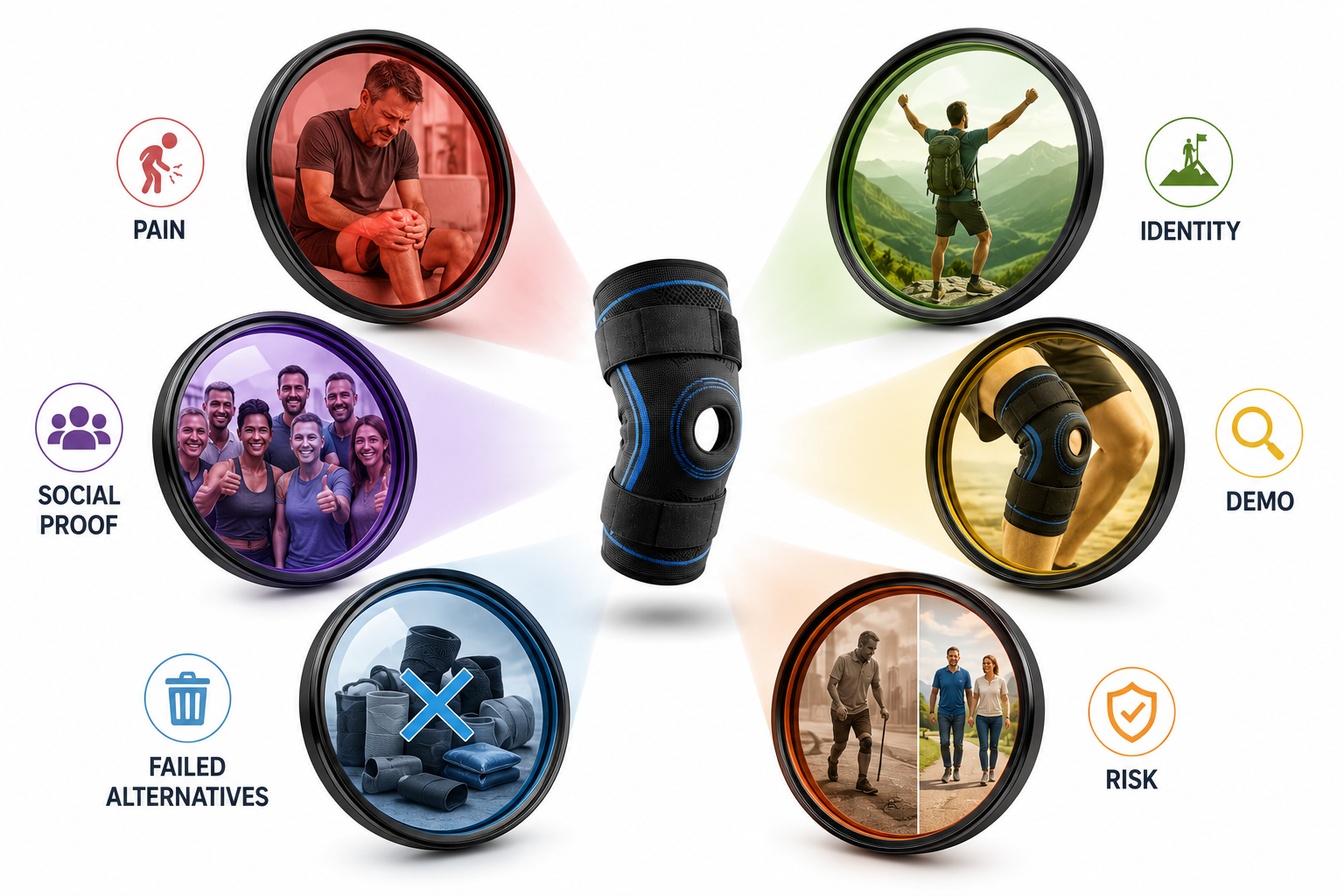
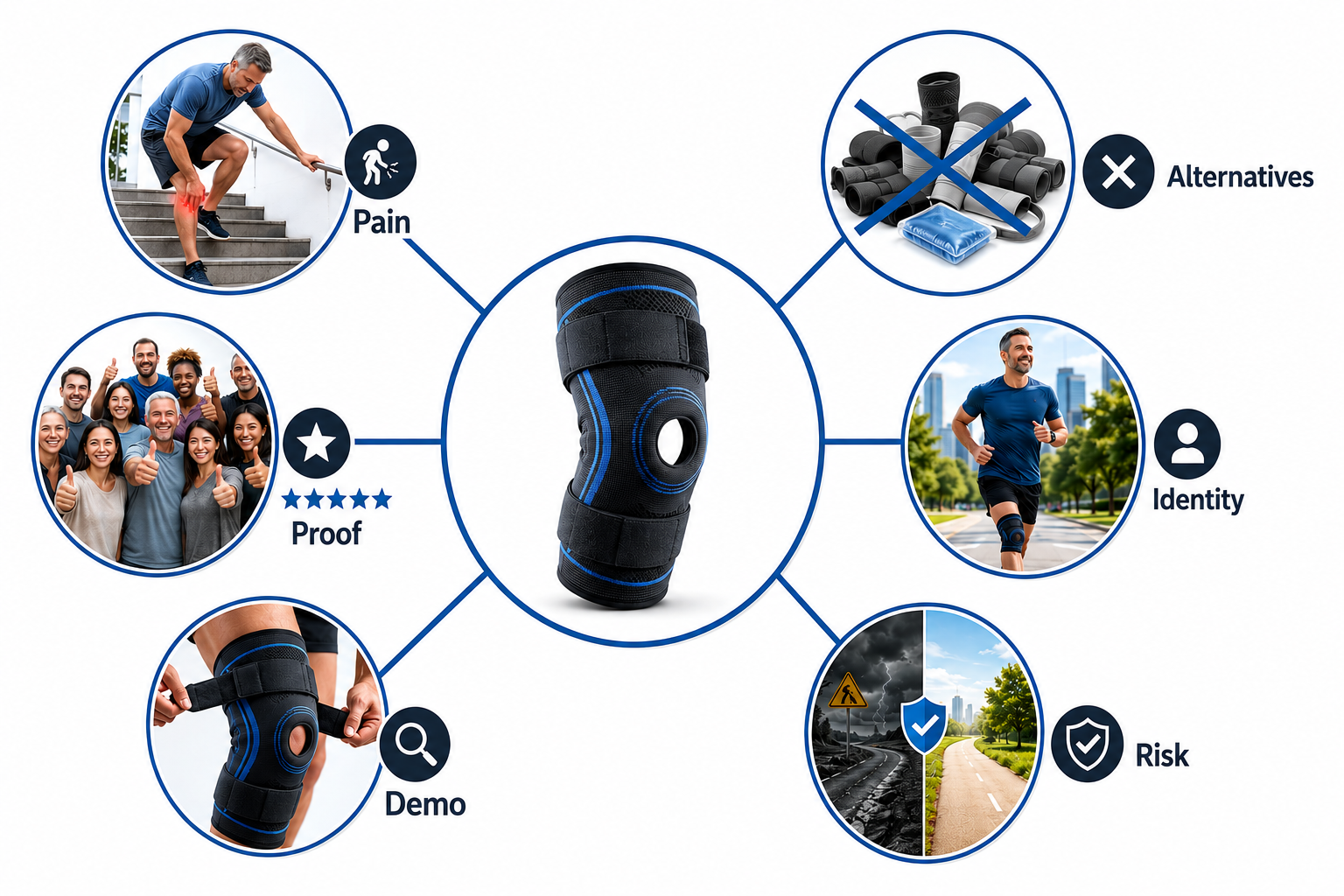
Same product, same store, same budget — two operators get completely different results. Why? The angle. Your angle determines which buyers pay attention, which emotion gets triggered, and which version of the product people actually want to buy. Testing one angle is not testing the product. You haven't genuinely tested a product until you've run multiple distinct positioning strategies against it.
Most operators test 1–2 angles and call the product dead. You need 6 distinct angles before you can make that call. This module shows you what those 6 angles look like — and how to brief them so production is fast.
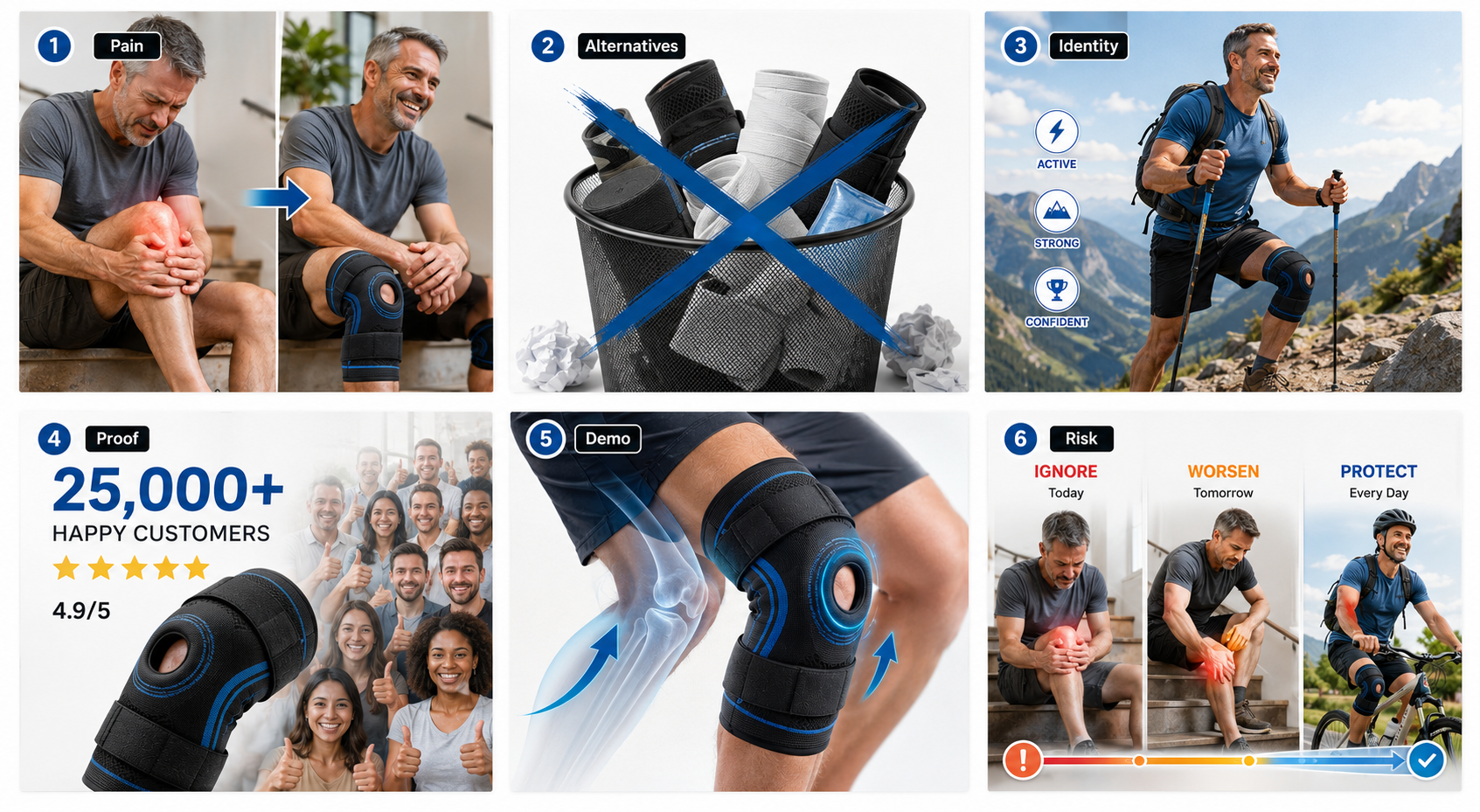
The 6 Core Angles — With Examples
Lead with the pain. Make the viewer feel understood before you show the product. Example: "If your knees ache every time you go up stairs, this might be the reason why." Then solution reveal. This angle performs consistently because pain creates urgency. Best for: health products, productivity tools, anything solving a recurring frustration.
Position your product as the solution to the failure of every other solution the viewer has already tried. "I tried 6 different braces, physical therapy, and ice packs. Nothing worked until I tried this." Builds immediate credibility because it acknowledges their experience. Best for: markets where buyers are frustrated after trying competing products.
Sell the identity, not the product. "The kind of person who has their mornings completely organized" — then show the product. "Active again after 50" — then show the knee support. This works because people buy products to signal something to themselves and others. Best for: lifestyle niches, fitness, home organization, fashion accessories.
Lead with proof: number of units sold, reviews, specific testimonials. "200,000 grandparents are sleeping better because of this." This overcomes the #1 cold-traffic objection: "Is this real? Can I trust this?" Best for: products with strong review data, anything with broad demographic appeal, trust-sensitive health products.
No talking. No copy. Just show the product doing the thing it does. A cleaning gadget removing stains. A posture device snapping into position. A knife slicing through a vegetable. ASMR style. This converts because it removes skepticism instantly — the buyer can see it working. Best for: visually demonstrable products, gadgets, tools, anything with dramatic visual results.
Lead with the consequence of inaction: "Most people ignore this symptom until it becomes a serious problem." Then position the product as the simple prevention. Uses loss aversion — which is psychologically stronger than desire. Best for: health, safety, and preventative products. Use with care: over-dramatizing creates policy risk and destroys trust if the product doesn't deliver.
Write one brief per angle — right now
- Open a doc. Create 6 sections: Pain-Solution, Failed Alternatives, Identity, Social Proof, Demonstration, Fear/Risk.
- For each: write 2–3 sentences describing the hook and the emotional frame for YOUR product.
- This brief becomes your creative brief for Module 09. 30 minutes of work here saves hours later.
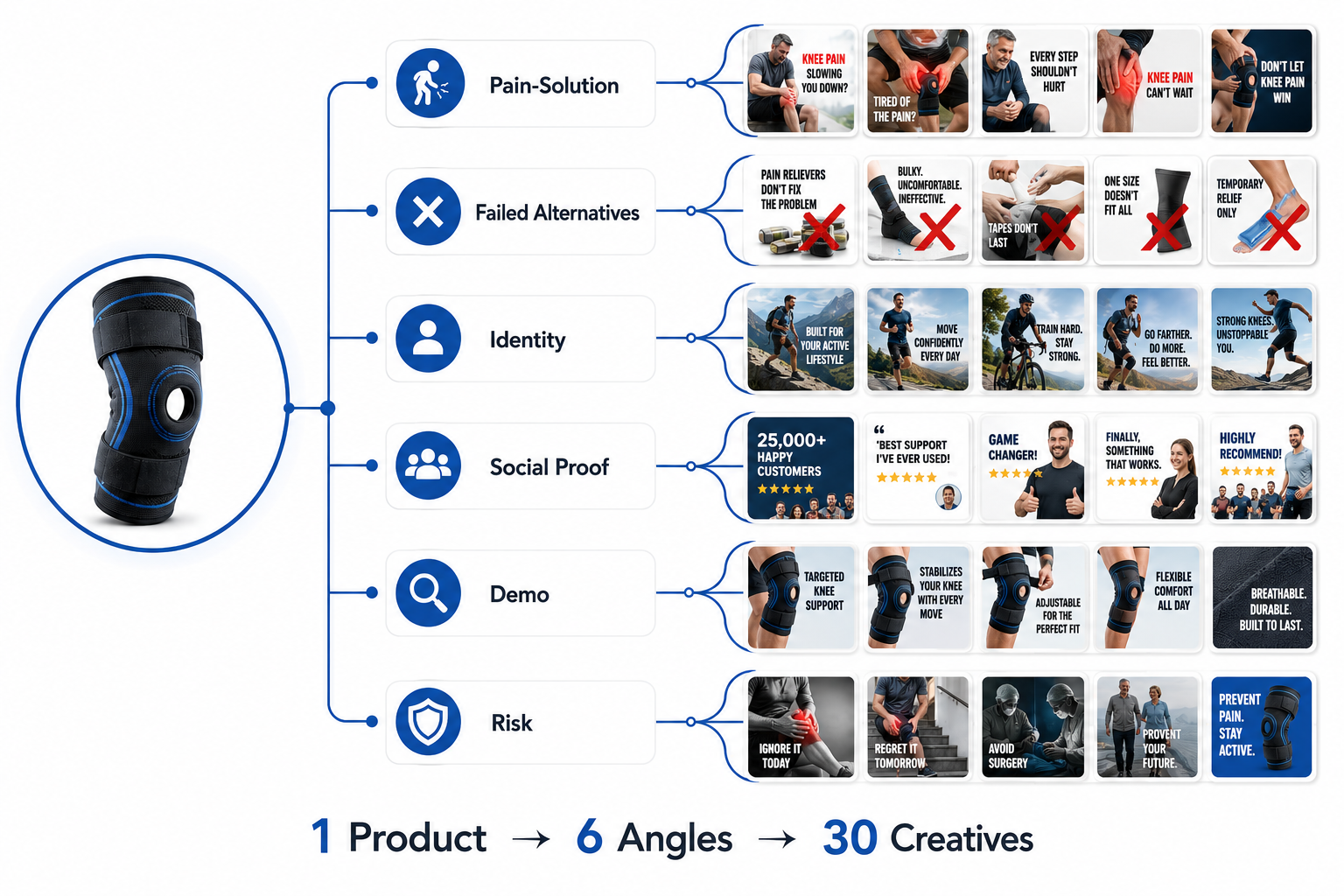
Angle Testing Matrix
For each product, plan 6 angles × 5 creatives per angle = 30 creatives minimum before launch. This is not overkill — it's the minimum to let the algorithm find what resonates.
| Angle | Hook Type | Best Format | Typical Performance |
|---|---|---|---|
| Pain-Solution | Empathy opener | AI video, talking head | Consistent mid-performer across niches |
| Failed Alternatives | Story opener | VSL, AI video | High-performer for saturated niches |
| Identity Upgrade | Aspiration opener | Lifestyle video, static | High when niche is identity-driven |
| Social Proof Cascade | Number/stat hook | Static ad, short video | Consistent but rarely the top performer |
| Pure Demonstration | Visual hook (no text) | Short video, GIF | Often surprise winner — test first |
| Fear/Risk Reversal | Consequence hook | VSL | High risk of policy flag — use carefully |
The audit behind this course identified creative angle selection as the #1 point where operators waste their first $300–$500. Before spending on ads, make sure your angles are genuinely differentiated — not 3 versions of the same idea. Use the product research module and the angle framework above to build 4–6 distinct ones before going anywhere near a camera.
📚 Brands to Study in Your Niche
The fastest way to understand what angles, offers, and creative formats work in a niche is to study the brands already winning in it. Below are curated brands by category — not to copy, but to benchmark. Each category has a note on what specifically to study. Pick 2–3 brands per category maximum — look for patterns, not a full audit.
Study their pain-solution hooks, social proof structures, and how they handle medical claims compliantly.
Study how they use identity angles, before/after structures, and community-driven social proof.
Study UGC formats, transformation hooks, ingredient-led copy, and how they stack social proof.
Study pure demonstration hooks, problem-reveal formats, and lifestyle aspirational positioning.
Study emotional hooks (guilt/love), UGC reviews, and pet owner identity angles.
Study aspirational identity hooks, lifestyle-first creative formats, and influencer/UGC blends.
Study compliant claim structures — how they imply results without triggering ad rejections.
Where to Find Creative Angle Ideas
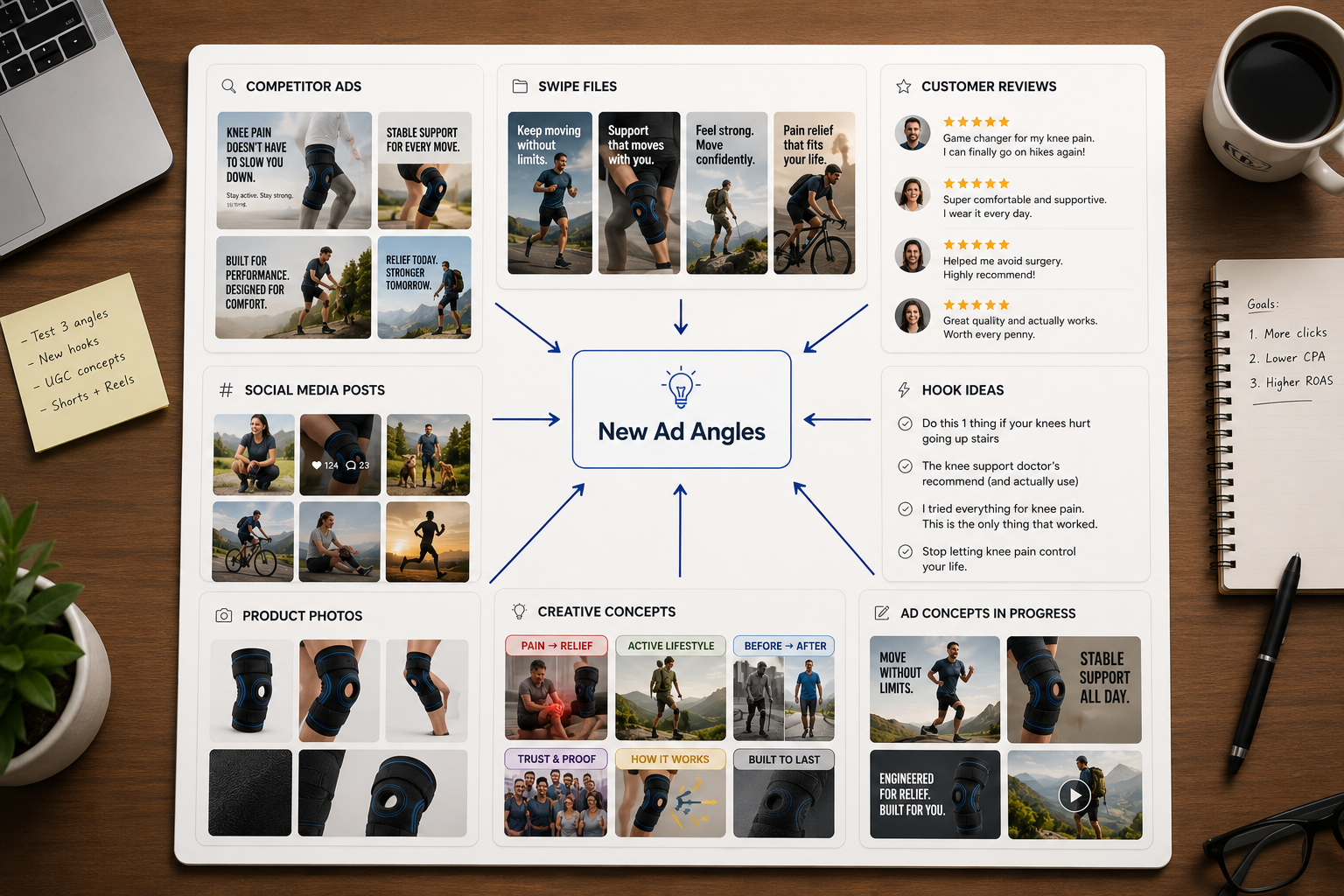
Knowing the 6 core angles is step one. Finding fresh ideas for how to execute them is step two. Most operators run out of angle ideas after 2–3 tests — these three sources give you a near-infinite supply.
Look at what successful brands in your niche are already doing on Facebook, TikTok, and Instagram. Analyze their ads — not to copy, but to understand what emotional trigger they're pulling, what hook format they're using, and what offer structure they're leading with. Take notes on: what visually catches your attention in the first 2 seconds, how they open (pain, story, demonstration, claim), and how they close (discount, urgency, guarantee). What works for a competitor in your niche is an informed bet that it can work for you — with a different execution.
If you've run ads before, your winning creatives are your best source of new ideas. Instead of starting from scratch each test cycle, create variations of what already worked. Change the hook while keeping the body. Switch the format (static to video, or vice versa). Test a different opening emotion — the same angle, but opening with curiosity instead of pain. Highlight a different feature or benefit in the same ad structure. Changing one variable at a time from a proven winner gives you signal-efficient data and often discovers the creative that outperforms the original.
A swipe file is a personal collection of ads, hooks, headlines, and creative formats that caught your attention — from any brand, any niche. Save screenshots, bookmark videos, and drop links into a Notion page or folder organized by what you found compelling: the hook, the visual, the offer, the CTA. When you're stuck, open the swipe file. You're not looking for something to copy — you're looking for structural inspiration. A strong hook from a skincare ad can be adapted into a hook for a back pain device. The formula transfers even when the product doesn't.
We've done a big part of this work for you — refer to the Swipe Files section of this course for 5,000+ real ads compiled across multiple niches. Use those boards as your first reference point before building your own.
Build your swipe file as you research — not retroactively. Every time you're in the Ad Library, TikTok Creative Center, or scrolling competitor ads, drop the standout ones into your file immediately. One folder for hooks, one for offer structures, one for visual formats, one for CTAs. Organized by category means you can pull what you need in 5 minutes when briefing your next creative batch — rather than trying to remember an ad you saw 3 weeks ago.